Energy System Development: The Ultimate Guide
What does it mean to be “conditioned” or to do “conditioning?”
Often times when people think of working out, their first thought is training a muscle. This isn’t always the case, though.
Many times, the purpose of a training is to improve your body’s energy systems. In other words, it is to train how efficiently your body can use its stores of energy. Building these up is what “conditioning” is all about.
So, the purpose of this article is to explain what these energy systems are and how to train them; without getting too in the weeds of their biochemistry.
There are three different energy systems that are relevant, and we will break them all down together.
If you have any unanswered questions as we go along, I encourage you to comment below and I will get back to you at my earliest convenience.
ATP: The molecule of energy
You may or may not have heard of this compound before.
ATP is an acronym for adenosine triphosphate. It is a molecule of adenosine that is holding onto three phosphate groups (hence, triphosphate).
When ATP releases one of these phosphate groups, it becomes adenosine diphosphate (ADP; “di” = 2). This chemical reaction of releasing a phosphate group releases the energy that we use to move.
At any given point in time, your body has a given amount of ATP stored. However, this ATP store depletes quickly.
The goal of the energy systems in your body is to continually replenish ATP as we deplete it during exercise.
The energy systems will mainly differ in how much ATP they are able to produce and how quickly they are able to do so.
When we train our energy systems, we are working to improve their ability to produce ATP.
This will result in the energy system being able to provide energy for longer or allowing you to do more work in the same time constraint.
Energy systems overview
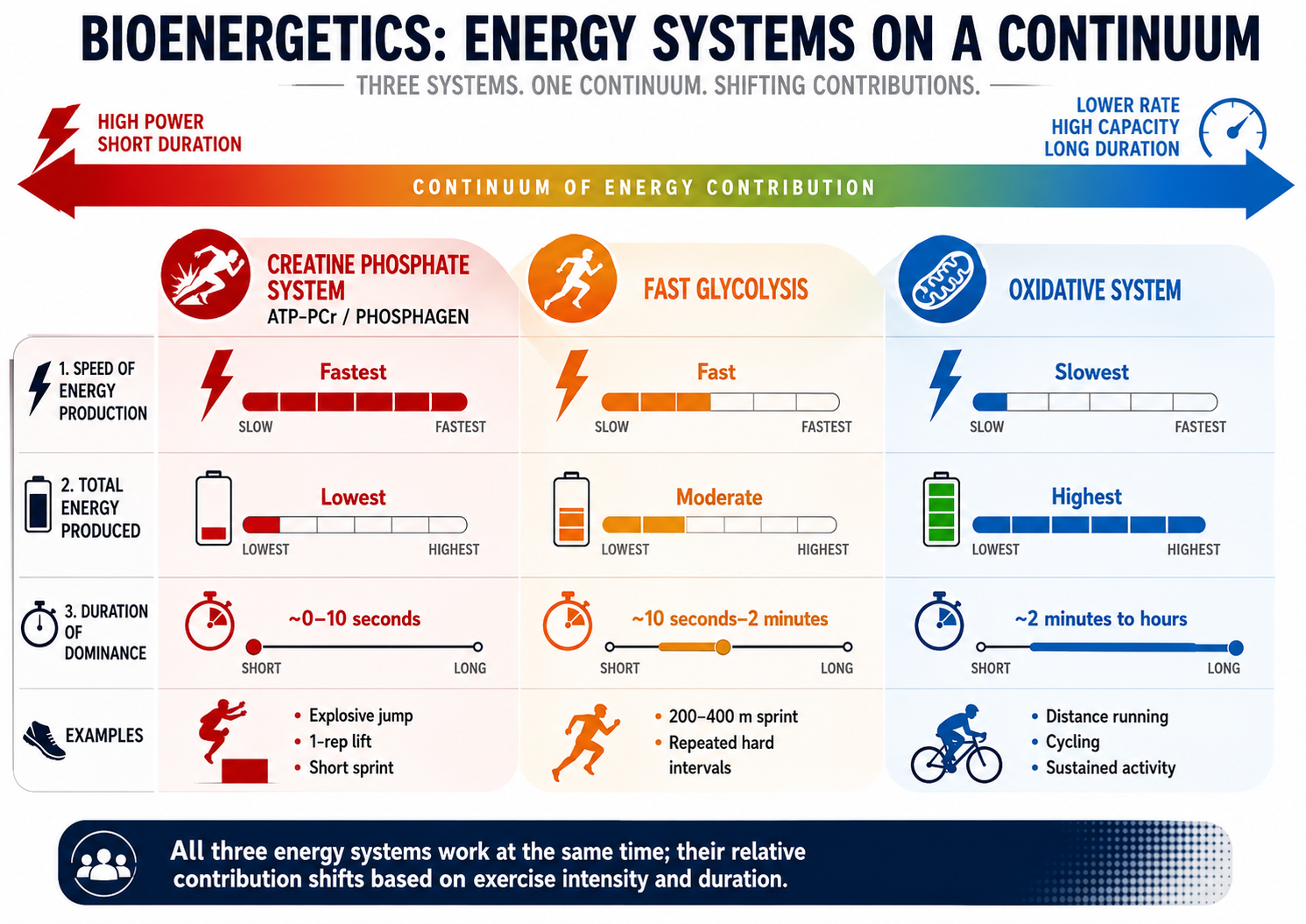
There are three distinct systems that will be discussed here today.
They differ in how quickly the can produce energy, how much energy hey can produce, and how long they can do it for.
This has implications for which is being used during different kinds of exercise.
You should note that the names of the energy systems can sound overly fancy and scientific.
As I mentioned before, I do not intend to go deep into the weeds of their chemical mechanisms.
So, don’t let their names turn you off.
First: the creatine-phosphate system.
This energy system can produce ATP very quickly, but it cannot produce a lot of it.
Second: fast glycolysis.
It can produce more energy than the creatine-phosphate system and lasts a little bit longer, but it cannot produce the energy as quickly.
Third: the oxidative system.
This energy system can produce a TON of energy and it can do so for a SUPER long time. However, it is slow to produce this energy relative to the previous two energy systems.
Exercise Modalities for Conditioning
Which energy system is predominately contributing to a bout of exercise is determined by the intensity of the exercise; and by extension the duration of the exercise.
For instance, say you are doing a bout of activity that is high intensity enough to stress the creatine-phosphate system.
Exercise at this intensity can only be sustained for a limited period of time; only about ~10-30 seconds or so.
As a result, hitting fatigue within that limited period of time is associated with training the creatine-phosphate system.
In line with this, the mode of exercise you choose to perform does not have an impact on which energy system is being trained. Only the intensity and duration do.
That said, certain exercise modalities are better for specific energy system conditioning than others.
Take squats, for example.
You could modify the load used to where any of the listed energy systems are the primary contributor.
However, there are other aspects of this exercise that may limit performance, such as force production capacity of the relevant musculature.
In any training you do, what limits the exercise is what gets trained.
So, if you want to develop your energy systems, you need them to be the primary limiting factor to the exercise you’re doing.
For conditioning purposes, a good exercise should:
be cyclical
have low eccentric demand (when a muscle is lengthening, or when a weight is being lowered)
not have super high impact forces (relatively speaking)
Under these parameters, modes of exercise I commonly recommend for conditioning include:
Running
Cycling
Swimming
SkiErg
AirDyne
Rower
Sled work
The Creatine-Phosphate System
As we've mentioned, the energy systems differ in how quickly they produce energy and how much of it they can produce.
The creatine-phosphate system produces energy the fastest, but it can produce the least amount of energy.
The result of this orientation is that it is mostly used in bouts of activity where you hit fatigue within ~5-30 seconds.
You may see a different time range noted across various sources and it will vary somewhat person to person. However, it’s true extent is somewhere in that ball park.
The fuel source for this energy system is the stored creatine phosphate within your muscles.
A molecule of creatine phosphate will donate its phosphate group to a molecule of adenosine diphosphate (ADP), therefore converting it back to adenosine triphosphate (ATP).
As we mentioned before, this molecule of ATP can now be used to fuel movement.
The best way to program creatine-phosphate specific training is to treat it much like you would treat a set of strength training.
Use any of the exercise modalities listed above
Perform an all-out sprint for somewhere between 5-30 seconds
Rest for ~2-3 minutes
Repeat for a planned number of sets
This energy system explains the benefits that are derived from creatine supplementation.
Creatine is a molecule that’s naturally produced in our bodies and found in food.
However, we usually only have about ~40-60% creatine saturation within our muscles, and it is impractical to fill this gap from food alone (you would need ~3-5 pounds of red meat per day, for example).
So, creatine supplementation serves as a simpler way to reach muscle saturation. The fuel stores for this energy system become maximized, and then your performance on any activity relying on this system is improved.
Moreover, the training of this energy system becomes that much more effective.
For more on creatine supplementation, see the following articles:
Fast-Glycolysis
Fast glycolysis is the the energy system that works a little slower than the creatine phosphate system.
However, it lasts longer and produces more energy.
This energy system is the primary one used during bouts of activities in which you fatigue within ~30 seconds to 2 minutes.
The fuel source for this energy system is carbohydrates specifically.
As a matter of fact, that’s exactly what the name means (glyco = carbohydrate; lysis = breakdown).
Molecules of carbs are broken down in a systematic manner, and energy is produced along the way.
There are two ways that I like to program training of the fast-glycolytic energy system.
The first option is with the same strategy as was explained for the creatine-phosphate system.
Perform a 30 second to 3 minute, maximum effort bout of exercise on any of the aforementioned modes of exercise. Rest ~3-5 minutes in between sets. Repeat this for a planned number of sets.
Another option is with intervals.
In other words: do some easy work for a period of time, some hard work for 30 seconds to 3 minutes, and repeat for a planned number of intervals.
My preferred way of programming intervals for the purpose of developing this energy system is as follows:
Work at a 5/10 effort for 2 minutes
Work at an 8-10/10 effort for 2 minutes
Repeat for 3-5 intervals
Krebs Cycle/Oxidative Phosphorylation
The final energy system we’ll cover is the oxidative system.
This one produces energy the slowest, but it produces a massive amount of energy- infinitely more than the previous two.
This energy system is also what primarily fuels your body at rest.
In addition, in between sets of lifting or hard conditioning, this energy system is fueling the recovery your body needs. So, developing this energy system has the potential to improve the efficiency of the previous two.
Any activity in which you would reach fatigue in more than 3 minutes is going to be primarily fueled by this energy system.
Training this energy system is typically what it means to do “cardio.”
There are three ways I recommend programming for oxidative energy system development.
The first method is long slow distance training. Functionally, this can be seen as the same as zone 2 training.
With this method of training, you perform work at an intensity of ~55-75% of your maximum heart rate. Then, ideally, you perform as much of this kind of work as your schedule allows.
The second method is to perform a high effort bout of exercise that lasts longer than 3 minutes (ideally longer than 4 minutes).
An example of this could be running as far as you can in 10 minutes’ time.
The third method is to use intervals.
Intervals for the purpose of oxidative development might look as follows:
4 minutes at a 5/10 effort
4 minutes at an 8-10/10 effort
repeat for a planned number of intervals
Clearly, the first method here is much different than the second two insofar that the first maintains low intensity the entire time while the second two methods would feel much harder.
There are a number of different points in this energy system that may be the system’s limiting factor. The low intensity and high intensity oxidative training target different aspects of the process; so it is fair to say that each are equally as important.
Programming It All Together
There are many different kinds of training strategies we’ve discussed so far.
However, something I commonly tell people is that a training session is only good insofar that it fits well into a program at large.
So, it’s worth discussing how you might go about combining the mentioned training styles within themselves as well as combining them with resistance training.
To start, training the creatine phosphate system as mentioned previously can be easily integrated into a resistance training session.
For instance, you might start a full body workout with 3 sets of 10 second sprints on an AirDyne, and then proceed to perform hypertrophy training for the remainder of the session.
I typically recommend performing the high intensity glycolytic or oxidative sessions only once, maybe twice, per week.
This sort of training is some of the most intense and strenuous that you can impose on your body. Performing too much of this sort of work can send recovery needs through the roof, and make it difficult to perform other kinds of intense training such as resistance training.
Plus, one session per week is usually plenty to get the training adaptations you’re after anyways.
If you are using an interval session for your high intensity conditioning session of the week, then you may end up orienting the session to be more glycolytic or more oxidative. That is okay, you don’t need to have an interval session for each.
In any case, glycolytic interval sessions will still benefit your oxidative system and vice versa. It just isn’t as direct of a benefit.
So, you don’t need to worry about losing your glycolytic capacity if you don’t have a glycolytic specific session in your week.
However, if you want to train both with intervals, you can get creative with how you design the session.
For instance, say you are going to have rounds of intervals in a session. The first two could be oriented toward fast-glycolysis, and the last three could be oriented toward the oxidative session.
The point is: you can write up the session to fit whatever your goals or preferences are.
If you are performing single sets of conditioning, then you can combine all three into the same session if you’d like.
Here’s an example using a track:
2 sets of 100 m
2 sets of 400 m
2 sets of 1200 m
~3-5 minutes of rest in between sets
All sets are max effort
Of course, I would also recommend a warm-up. I am excluding one here to stay on task with this article’s goals.
References
Haff, Gregory G., Triplett, Travis N., 2016, Essentials of Strength Training & Conditioning, 4th edition.