Cycling vs Running
What’s the better form of cardio: running or cycling?
At first glance they may seem interchangeable, but the truth is they are quite different.
In this article, I’ll explain what those differences are so that you can be more effective with which one you choose to do.
We’ll cover:
Mechanical differences
Systemic vs local effects
Lactate & heart rate during cycling vs running
Ceiling effect (how fast can you progress? can you do “too much?”)
Which is better for building endurance?
Which is better for weight loss?
Summary bullet-points
Mechanical differences
The most important difference to discuss is the presence or absence of impact.
Cycling is zero impact. Running is both high impact and high volume of impact.
This makes running more intense than cycling, but why?
The reason is because impact necessitates eccentric muscle contractions, and not just concentric muscle contractions.
An eccentric muscle contraction is how your muscles contract when the muscle is lengthening, or you are lowering a weight.
Take a squat, for example. The way down of the squat is the eccentric portion, and the way up is the concentric portion.
Every time your foot lands while running, your legs perform eccentric muscle contractions in order to accept the landing.
This then occurs over the thousands of steps that make up a run.
Conversely, eccentric muscle contractions are never utilized while cycling.
Eccentric muscle contractions are more intense, more fatiguing, and require more recovery than eccentric muscle contractions. [1]
Thus, running is more fatiguing and requires more recovery than cycling (when intensity and volume is matched).
Systemic vs local training
Your upper body is actually quite active when you are running.
It acts as a counterweight and provides momentum to your lower body, therefore increasing speed without your legs needing to work harder.
Cycling, on the other hand, has almost no upper body involvement relative to your lower body. This is especially true of stationary cycling.
The reason this matters is because some aerobic adaptations affects the whole body, while others only affect the specific muscles that are working.
These systemic, whole-body adaptations can be achieved with both running and cycling.
The local adaptations will also be achieved in your legs from both cycling and running.
Your upper body won’t experience any meaningful local aerobic adaptations from cycling, though- only form running.
Lactate and heart rate
The heart rate targets you have for running don’t transfer over perfectly to cycling.
If you attempt to use your running heart rate targets on a bike, you will end up killing yourself in a session that shouldn’t have been so hard.
To understand why, we first need to cover the below graph:
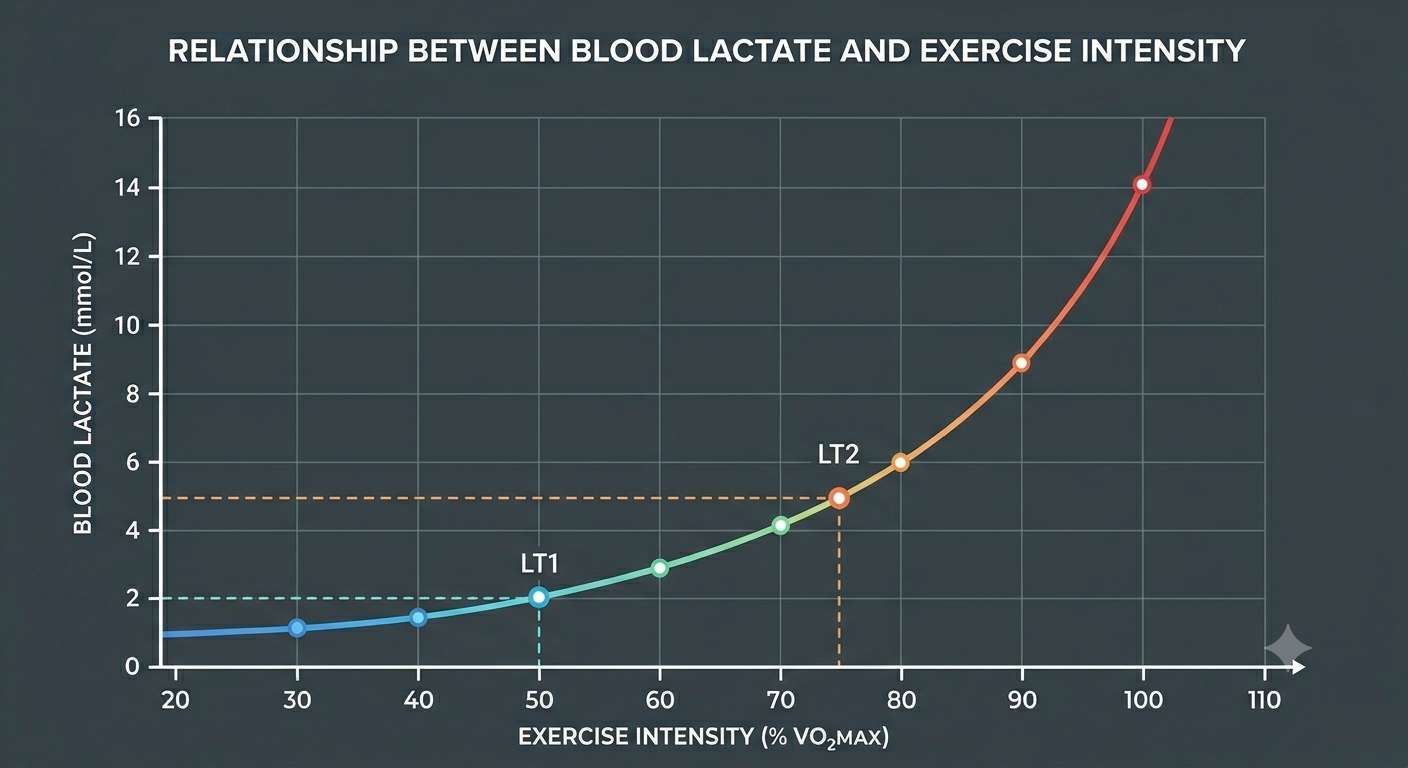
As intensity of exercise increases, there comes a concordant increase in blood lactate produced from the working muscles.
This build up in blood lactate contributes to fatigue and performance decrease as exercise is prolonged.
There are two points at which the increase in blood lactate accumulation itself increases. The first (LT1) is at ~2 mmol of lactate per Liter of blood, and the second is at ~4 mmol/L.
The purpose of using heart rate zones is to approximate where you are on this graph.
For instance, the purpose of “zone 2 cardio” is to put yourself right beneath the first lactate threshold (LT1), but not past it.
The same heart rate can put you at very different points on that graph on two different exercises.
Heart rate is a whole-body measurement, while lactate accumulation is a local phenomenon.
Because your heart doesn’t need to pump blood to your upper body during cycling the way that it does for running, you will hit these lactate levels in your legs at a much lower heart rate.
This is why 140 bpm might feel easy while running but hard on a bike.
Ceiling effect (can you do “too much”)?
As a general rule of thumb, short-term spikes in volume are the #1 risk factor for injury across all kinds of training.
The difference between running and cycling is that cycling tends to be much more forgiving than running, mostly due to the mechanical differences we spoke about before.
For running, injury risk increases if you run a distance that is 10% longer (or more) than your longest run in the last 30 days. [2]
For cycling, an increase of 30% compared to your longest ride in the last 30 days increases injury risk. [3]
A similar relationship is seen long-term as well.
Recreational runners tend to have 1/3 the osteoarthritis risk compared to non-runners, but professional runners (e.g. your income depends on running) tend to have slightly increased risk of osteoarthritis compared to non-runners. [4]
In other words, running reduces risk of osteoarthritis until it is pushed to the absolute highest level.
For cycling, no such change in effect has been observed. The more cycling a person does, the less risk of osteoarthritis they have. [5]
The more lens you attempt to view this through, the more you see this relationship play out.
The bottom line is this:
You CAN do “too much” of either running or cycling.
Progressing your training at the right speed is what will determine the progress you see or the injury risk you incur.
That said, it is much harder to overdo it with cycling than it is for running.
Cycling vs running for building endurance
All that said, which is ultimately better cardio: cycling or running?
To start, cardiovascular fitness is task specific.
A person who is an excellent swimmer will be said to have great endurance, but that probably won’t translate well to running.
Cycling is better than running for improving cycling performance. Running is better than cycling for improving running performance.
So, if your goals involve improved performance in either of these disciplines specifically, then that should dictate which you do.
If I had to say which is better for developing cardiovascular fitness overall, my rank order would be:
Doing both across the week
Running
Cycling
I prioritize running over cycling because it is more “full-body” and more intense than cycling, as discussed before.
This means the aerobic adaptations that you are after will occur across your entire body, and not just your legs.
Plus, it will be easier to reach your maximum heart rate with running. You shouldn’t spend a lot of training time at your maximum heart rate, but it is important to spend some time there.
I prioritize both over one or the other for a couple of reasons.
First, doing both across a week will provide you with all of the same benefits that running alone will; with much less fatigue or recovery demand. This can lend to you feeling fresher day-to-day as well as making the combination of endurance training and strength training easier.
Second, you can progress cycling much faster than running without reducing injury risk, as mentioned before. You might find yourself at a point in the week where adding more running volume is unwise, but adding cycling volume is perfectly safe. In this way, you can “force” more aerobic adaptation to occur than if you were only running.
Anecdotally, most of my clients who are high level runners (50+ mile competitors) tend to feel and perform better when they use a combination strategy as opposed to running alone.
Cycling vs running for weight loss
Let’s first acknowledge the non-negotiable conditions for optimal fat loss (meaning fat loss specifically, not weight of any kind):
Calorie deficit of ~5-10% or 250-500 calories (your body burns more energy than you take in per day) [6]
Sufficient protein intake (0.72-1.0 grams of protein per pound of bodyweight) [7]
Proper exercise training
The best research on training for fat loss indicates that a combination of strength and endurance training produces the best results. [8]
Both running and cycling can work here, but running does seem to be more effective.
This is true for two reasons.
First, running will burn more calories per unit of time than cycling will, due to its higher intensity and full-body recruitment.
Second, when total calories burned per exercise session are matched, running seems to be better for reducing abdominal fat (body fat around your trunk) as well as visceral fat (body fat around your organs). [9]
Again: I would still argue for both cycling and running together being more advantageous than either alone for the same reasons as before.
If I had to pick one, though, it would be running.
Summary bullet-points
The following are the key points from this article:
Running is more intense than cycling due to the impact (and therefore eccentric muscle contractions).
Running has a much higher involvement of the upper body compared to cycling.
Lactate thresholds are achieved at lower heart rates with cycling than running. Thus, lower heart rate targets should be used for cycling than running.
Proper progression of any exercise is what will dictate whether you see improvements or get injured. That said, cycling can be progressed much faster without injury risk.
For building maximum aerobic endurance, having a combination of cycling and running in your week will produce best results. If you had to pick just one, running would likely be the better choice.
The same rank order is true for weight loss.